Personal and expert advice
25 years of experience
Fast delivery times
Competitive prices



 Nederlands
  Deutsch
  Français

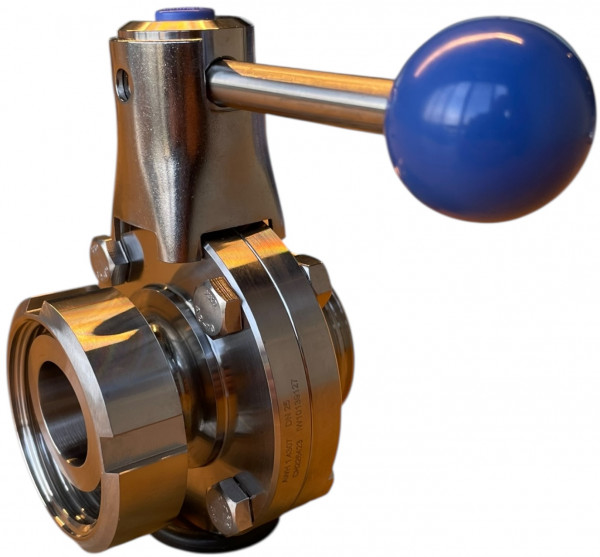
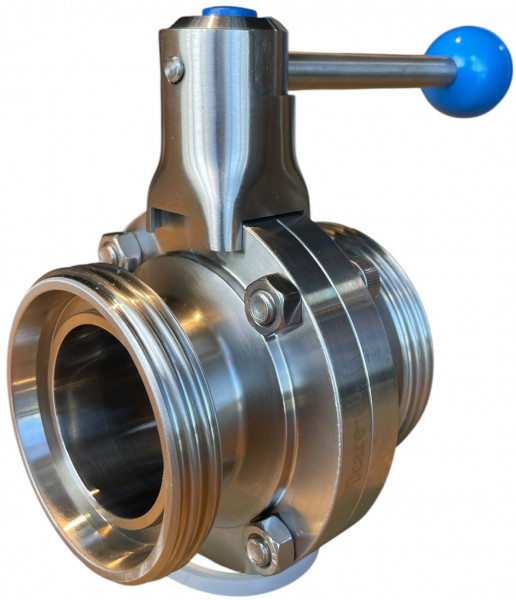
For opening and closing a product line this is the most widely used design in the food industry. The disc turns in the flow and seals against an elastomer seat. That keeps the face-to-face length short, the operation quick and the resistance low. Because the butterfly valve carries a standard coupling on both ends, you fit it between two existing connections without altering the pipework at all.
The hand operated version has a lever with a catch in several positions, so you can throttle as well as shut off. The pneumatic version works from an actuator on compressed air and is single or double acting. Single acting falls back to a safe position on air failure, which on a product line is almost always closed. Double acting stays where it was.
The body is 316L. The seat decides what the butterfly valve will take: EPDM for dairy and CIP with caustic, silicone for higher temperatures, PTFE for aggressive media. The seat can be replaced on its own, so wear does not mean replacing the whole butterfly valve. Check the disc for scoring when you strip it, because those marks carry straight through into the new rubber.
Fit it with the shaft horizontal where you can, so that soil does not collect in the lower bearing. Leave the pipework free of stress. During CIP every butterfly valve has to stand open, otherwise the space behind the disc is never cleaned. Include the unit in planned maintenance, because the seat is and remains a wearing part.
We supply from DN25 to DN100. Bear in mind that the disc stays in the flow even when the valve is open. With very viscous products or on lines that are pigged that matters, and a seat valve is then a better answer than a butterfly valve. For milk, water and most beverages it makes no practical difference. Tell us the product and the cleaning temperature and we will advise on the seat.
There is a DIN 11851 half on each end, so allow one nut and one ring per side. You will find those under union nuts and under seals. Order them at the same time, because a butterfly valve ships without them. If you also want to see what is passing through at that point, fit one of the sight glasses next to it.
Didn't find the right DIN 11851 Butterfly valves?
Fill in the form below, and we'll assist you further!
Curious about our blog? Check out all our items here!
Contact us here